A day in the district, from a bakery to the Théâtre National
A year to bake the first loaf
We handed over the keys to 74, avenue Gaston Diderich almost a year before anyone in the Belair district tasted the bread. The obstacle was electricity. A bakery oven draws several times what a retail unit is wired for, and the connection had to be reinforced before Open Crumb could bake in its beautiful room. The oven is a Hein, built in Strassen. Through the shop window, you can watch Tiago shaping his delicious sourdough. A sourdough starter is a living dough: flour, water, wild yeasts and lactic bacteria that ferment slowly, often overnight, where industrial yeast raises a dough in an hour. That slowness gives the bread its open crumb, its thick crust and its slight tang, and keeps it fresh for several days.
Every day, cycling to the office, we passed the empty unit. Rent runs from the day of signature, and the takings wait for the oven. A knot in the stomach.
The day they opened, we walked over and bought a sourdough loaf. And natas. It was worth the year.
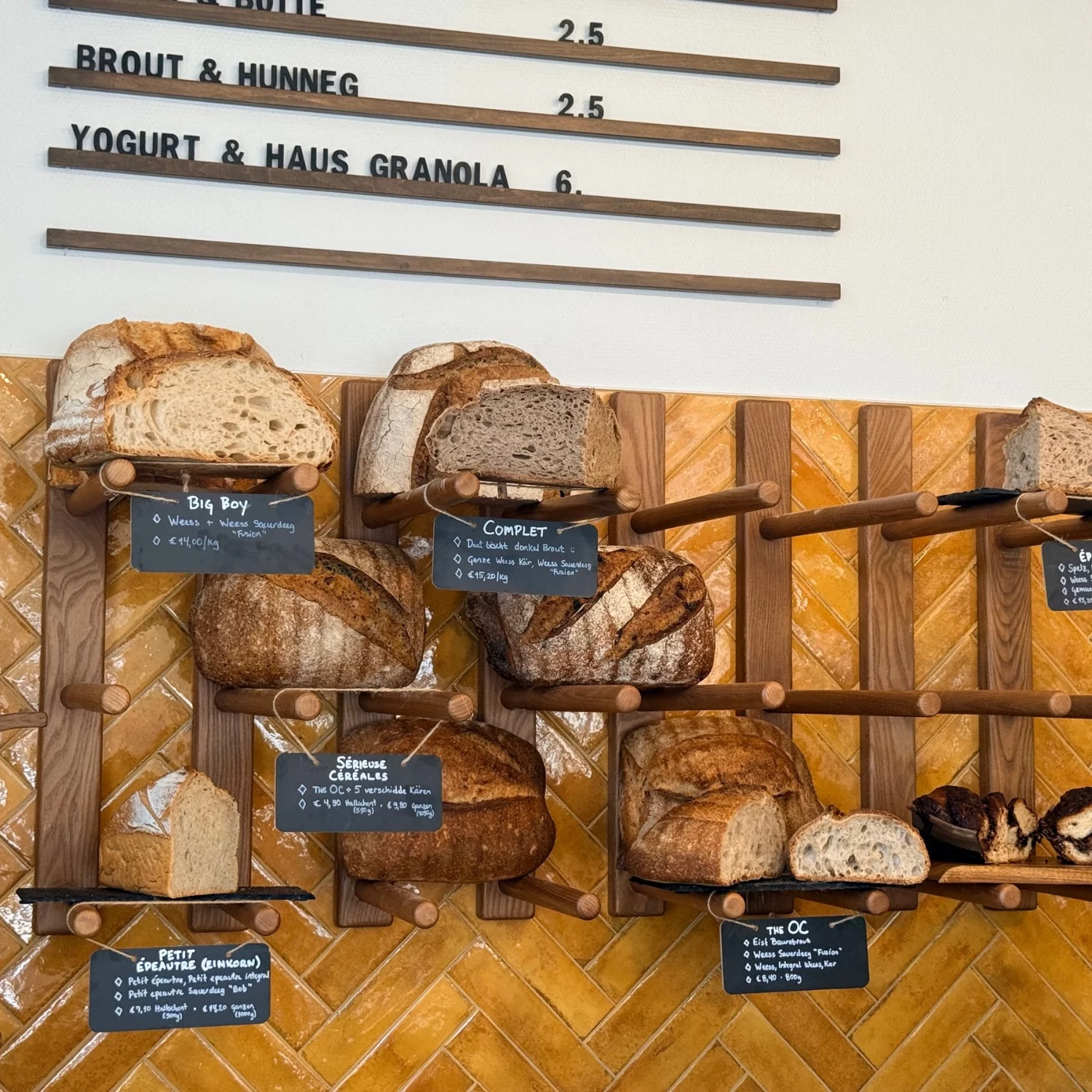
Look at what sits behind the counter and the delay reads differently. The rye comes from A Schéiwesch in Moutfort, stone-ground, twenty minutes up the road. The spelt comes from the Moulin de Vencimont in the Belgian Ardennes, twenty-five kilos at a time, the milling date written on the sack in red pen.
The tags on the bread wall are handwritten and tell you what is in the loaf rather than how it will make you feel. The grand épeautre is milled on an antique water mill. The house loaf is called The OC, eist Baurebrout. Their sourdough starters have names, and they work long enough to make the grain’s iron and magnesium easier to absorb, by which time an industrial dough is long out of the oven.
Robin and Tiago told their story to Marion Finzi for Kachen. Their starter is fifteen years old and it travelled here from Portugal.
A day in Belair
Once you have the bread, the rest of Belair falls into a day.
The morning belongs to avenue Gaston Diderich. Coffee at Florence Coffee round the corner on rue du Maréchal Foch, then up the street to Niessen, the organic butcher at 137, for whatever you are cooking tonight.
By midday you are on Val Sainte-Croix, where two tennis clubs feed the district for two different reasons. Café Bel Air at 99 for the burger and a beer list that runs on longer than the menu; book ahead, because the room fills. Arquebusiers at 140 when the lunch has an agenda. La Feluca sits higher up on boulevard Napoléon Ier, tucked in behind the courts, and the walk is what makes it the long Saturday instead of the quick Tuesday.
And for other days, Belair travels far: Ryôdô’s Japanese haute cuisine, Manzoku’s ramen on avenue du Dix Septembre, Indian cooking at Royal Bengal right opposite the Théâtre National, or the Rôtisserie Ardennaise for the big occasions.
Late afternoon is gelato. Bonomeria on rue Wurth-Paquet, where the queue runs out of the door and nobody minds. Then the park, which has two names depending on the street you walked in from: Merl to some, Belair to others, officially Parc de Merl-Belair, and the same ducks either way. The open-air photographs on the lawns change twice a year.
Evening opens with an apéritif at Pacha on avenue du Dix Septembre, where the tables mix ages the way a district should, and closes four minutes’ walk away at the Théâtre National on route de Longwy. A hundred and fifty seats. You can hear the actors breathe.
Belair is among the most expensive residential districts in the country. What gives it that value sits in a handful of small independent businesses that an electrical connection can hold back for a year.
After the Gare, Belair. A bakery is what brought us here.
The Grand Duchy measures 82 km from north to south and 57 km from east to west. Yet across those 2,586 km², prices per square metre double between the North and the most sought-after districts of the capital. The choice of region, then of district, will shape your quality of life for years.
Our series “Where should you live in Luxembourg?” helps you make it: the North, the South, the East, the West and Luxembourg City. We update these guides over time and will let you know when we do. We are adding portraits of the districts of the capital where we work, with the Gare and Belair already covered.