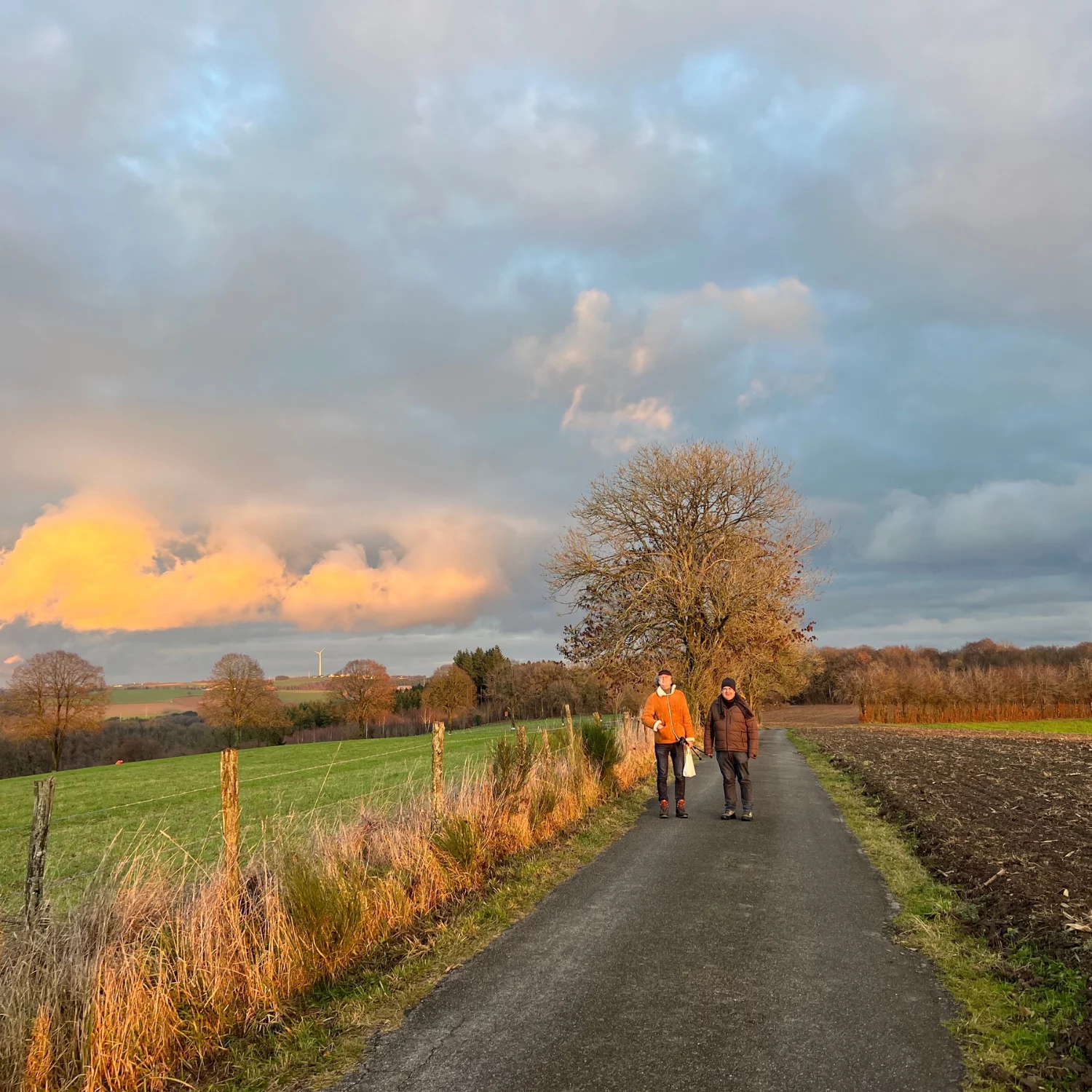
The North of Luxembourg was long seen as too far away. Things are changing. Remote working, free public transport and the search for quality of life are redrawing the map along new lines: clean air, open views, nature on the doorstep, sources of inspiration and energy.
The facts:
- Price per m²: 30 to 40% lower than in Luxembourg City
- Commute to the capital: 30 to 90 minutes depending on location
- Immediate access to nature: forests, rivers, lakes, vast wild spaces
- More than 40 circular walking trails, all signposted
- International schools within reasonable distance
Our favourite
map_pin_heartA perfect day in Clervaux at Christmas timebegins with a morning walk in the forest, followed by a gourmet stop in Eselborn. In the afternoon, take a quiet moment at vespers in the abbey, where the little shop also sells a delicious apple juice from the monks’ orchard. On the way back, in the winter dusk, the Christmas market appears as if by magic: the perfect moment for a well-earned mulled wine.
It’s days like this that remind us why we love the North of Luxembourg so much.
Diekirch,
the charm of a lively small town
Population: around 7,000.
Atmosphere: historic and lively.
- Pedestrian town centre with local shops
- Secondary school (lycée classique) and primary school with international sections
- Cycle paths along the Sûre
- Swimming pool, sports facilities, cultural activities
- Commute to Luxembourg City: 40 minutes by car, 60 minutes by train
Who is it for? Families looking for a balance between town and nature, people working from home two to three days a week.
Ettelbruck
the hub of the North
Population: around 10,000.
Atmosphere: dynamic, a shopping town.
- Main station with direct trains to Luxembourg City
- Nordstrooss shopping centre
- Hôpital du Nord and all administrative services
- Technical secondary school, full sports facilities
- Commute to Luxembourg City: 40 minutes by car, 49 minutes by train
Who is it for? Working people who want convenience without urban density, with easy access to public transport.
Wiltz, the soul of nature
Population: around 7,000.
Population: around 7,000.
Atmosphere: historic and lively.
- Surrounded by forests and hills
- Lycée du Nord, primary school
- Hiking, mountain biking, endless outdoor activities
- International open-air theatre festival in summer
- Commute to Luxembourg City: 60 minutes by car, 75 minutes by train
The trade-off: a daily commute to the capital of at least 60 minutes.
Who is it for? Full-time remote workers, nature lovers, families leaving urban stress behind.
Schooling: options for international families
In the North:
- Lycée classique de Diekirch
- Lycée technique d’Ettelbruck
- Lycée du Nord in Wiltz
- International sections in public schools
Nearby, 20 to 40 minutes by car:
- European School Luxembourg II, Mamer and Bertrange
- International School of Luxembourg, Hollerich
- Waldorf School, Limpertsberg, whose biodynamic farm is in Rollingen-Mersch
The North of Luxembourg is for you if
- You work from home two days a week or more
- Your housing budget is tight. With €2,500 a month: a house in the North, an average flat in the capital
- You’re looking for nature and outdoor activities
- You want a calm, safe family life
- You’re happy to trade urban density for space and quiet
Less suited if your office expects you five days a week in Luxembourg City, if you want to live without a car, or if you need lively nightlife.
Our advice
The North of Luxembourg has become a deliberate lifestyle choice, well beyond a simple budget solution.
The deciding question: does your work allow two days or more of remote working a week? If so, the North becomes very attractive.
The Grand Duchy measures 82 km from north to south and 57 km from east to west. Yet across those 2,586 km², prices per square metre double between the North and the most sought-after districts of the capital. The choice of region, then of district, will shape your quality of life for years.
Our series “Where should you live in Luxembourg?” helps you make it: the North, the South, the East, the West and Luxembourg City. We update these guides over time and will let you know when we do. We are adding portraits of the districts of the capital where we work, with the Gare and Belair already covered.